
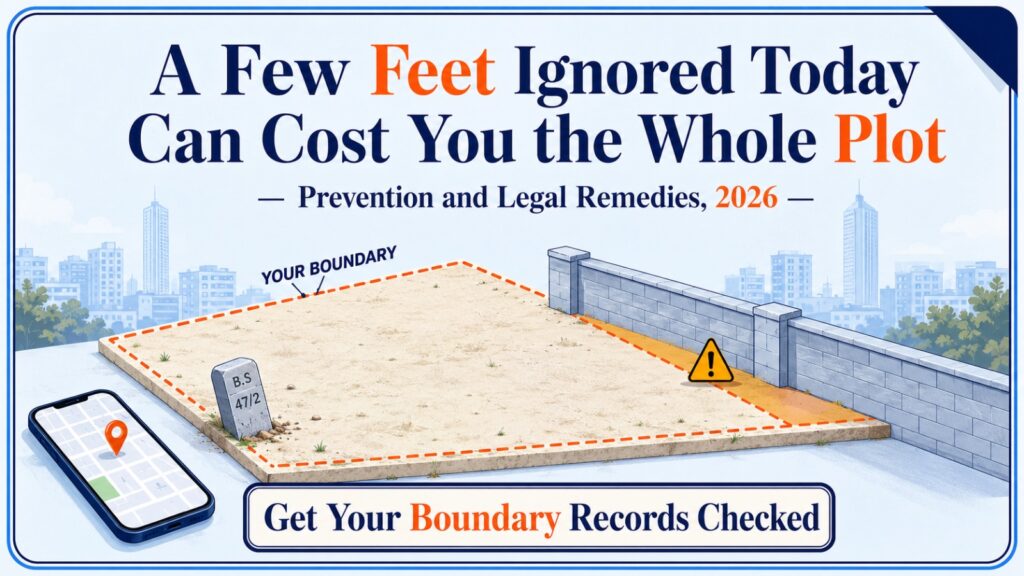
You visit a plot you haven’t seen in months, and something feels off. The neighbour’s compound wall sits deeper into your side than you remember. Or someone has been parking on your vacant site as though it were theirs.
It feels minor. It rarely stays minor.
This is land encroachment in Bangalore, and rising land values, poorly marked boundaries and long-absent owners have made it easy for a few extra feet to change hands without anyone signing anything. Most owners find out years later — when they try to sell, build, or apply for a loan. The good news: nearly all of it is preventable, and most of it fixable if you act early.
What Counts as Encroachment?
Any occupation or use of your land without your legal permission.
Sometimes deliberate, often not. A wall goes up off a wrong measurement, a survey stone disappears, an old survey number confuses two owners, and a boundary quietly drifts. The reason rarely matters in law. Ownership is decided by the recorded boundary — not by whoever is standing on the land today.
A neighbour’s wall three feet into your Whitefield plot is encroachment. So is a balcony past an approved line, a shed on adjoining land, or someone occupying an empty site because it looked unowned. Small or large, that strip still legally belongs to you.
Which is why a boundary dispute is never settled by argument. It’s settled by comparing the physical line against the survey number and the sketch in government records.
How Widespread Is It?
Far more than most owners assume — the official figures run into tens of thousands of acres.
| What was measured | The official figure | Source |
| Government land encroached, Bengaluru Urban | 38,947 acres | Revenue Minister Krishna Byre Gowda, Karnataka Legislative Council — Deccan Herald |
| Encroachment cases registered | 14,660+ | Same reply |
| Land freed from encroachment | 3,898 acres | Same reply |
| Forest land encroached, Bengaluru Urban division | 2,045.5 acres | Forest Minister Eshwar B. Khandre — Deccan Herald |
| Lake land encroached across 183 active lakes | 235 acres | BBMP affidavit to Karnataka High Court — Construction World |
| Lakes partly encroached by private parties | 120 | Same affidavit |
| Lakes occupied by government agencies | 131 | Same affidavit |
| Lake land actually reclaimed | 7 acres, across 13 lakes | Same affidavit |
Figures as reported in Karnataka Legislature replies and court filings. Totals vary between statements and survey rounds.
Two things jump out. Government agencies are themselves among the largest encroachers — 131 lakes occupied for infrastructure. And note the recovery rate: 235 acres encroached, seven reclaimed. Getting land back is slow and heavily contested, which is exactly why prevention beats litigation.
Where It Usually Happens
| Type | What it looks like | Most common on |
| Boundary | A wall, fence or gate pushed past the property line | Adjacent residential plots |
| Structural | A balcony, staircase, shed or extension crossing the legal limit | Built-up areas, often against approved plans |
| Vacant plot | Parking, storage, temporary structures, farming | Investment plots, NRI-owned sites |
| Government land | Roads, footpaths, parks, lakes, BBMP/BDA/Revenue land | Public land citywide |
Structural encroachments carry a second layer of trouble, since they usually breach the sanctioned building plan too. But vacant-plot encroachment is the quietest and most dangerous — a “temporary” use has a habit of hardening into a possession claim.
The pattern behind most cases is simple: rising prices along the Devanahalli, Whitefield, Sarjapur and Hoskote corridors, boundaries never properly marked, records that no longer match the ground, and owners who rarely visit. An unwatched plot is an open invitation.
How Do You Check Your Own Land?
Start free, before you spend anything.
The warning signs are usually visible: a wall that seems to have shifted, construction unusually close to your line, missing survey stones, a neighbour claiming part of your land, or a gap between your papers and what the site looks like.
Before hiring anyone, use the tools the state already gives you. The Dishaank app, built by the Karnataka State Remote Sensing Applications Centre, overlays digitised village maps on satellite imagery and uses your phone’s GPS to show which survey number you’re standing on. Stand on your plot, open the app, confirm the parcel matches your papers. Free, and it takes minutes. It links straight to the Bhoomi land records portal for the RTC.
If something looks wrong, apply through the Mojini portal for a proper land survey Bangalore owners can rely on — a government surveyor is assigned for boundary fixation (Hadbast) or encroachment resolution. Fees run ₹500 to ₹3,000 depending on land type and area, taking 15 to 30 working days. That report becomes one of the strongest pieces of evidence you can hold if this reaches court.
Which Property Documents Protect You?
A registered deed alone doesn’t settle ownership. These work together.
| Document | What it establishes |
| Sale deed | Legal transfer of the property to you |
| Khata certificate and Extract | Your name in municipal and tax records |
| Property tax receipts | Continuous ownership and civic compliance |
| Encumbrance Certificate | Freedom from loans, liens or disputes |
| Survey sketch / Tippan | The official measured boundary |
| Mutation records | Ownership change recorded in revenue registers |
| RTC (agricultural land) | Rights, tenancy and crop record |
| Approved layout plan | Sanctioned dimensions, where applicable |
Keep these current and complete mutation records promptly whenever ownership changes. Bengaluru owners should also secure the e-Khata, now central to city property compliance — our e-Khata covers the process.
One detail most owners never learn: if a boundary dispute arises and the digital map looks shifted, apply for certified copies of the Tippan and Akarband from the Survey Department. These original field measurement records carry more evidentiary weight in court than the Bhoomi RTC.
What Are Your Legal Remedies?
Whatever you do, don’t pull the wall down yourself.
Acting outside the legal process turns you from the aggrieved party into the one facing complications. Here’s how to remove encroachment from land lawfully.
Confirm the boundary. A licensed surveyor compares the site against government records and produces a report showing the exact line. Fences aren’t proof of boundary. Records are.
Send a legal notice. An advocate issues a legal notice for encroachment setting out the facts and a deadline to vacate. A surprising number of disputes end here — most encroachers would rather move a wall than defend a case.
Choose the right suit.
| Your situation | Remedy | Key point |
| Possession taken forcibly, recently | Summary suit, Section 6, Specific Relief Act, 1963 | File within 6 months. You prove prior possession and wrongful dispossession, not title |
| You want possession on the strength of your title | Suit under Section 5, Specific Relief Act, via the CPC | 12-year limitation under Article 65, running from when possession became adverse to you |
| You still hold possession and want it stopped | Permanent injunction, with temporary injunction under Order XXXIX CPC | Halts further construction while the case runs |
| Force, intimidation or intent to occupy | Criminal trespass, Section 329, Bharatiya Nyaya Sanhita, 2023 | Runs alongside the civil remedy; doesn’t replace it |
For government land, don’t file privately. Report it to BBMP, BDA or the Revenue Department. Under Section 104 of the Karnataka Land Revenue Act, 1964, the Tahsildar can summarily evict unauthorised occupants, remove structures and recover costs as arrears of land revenue, with criminal action possible under Section 192A.
Does the Land Grabbing Law Apply to You?
Only if government or institutional land is involved — the most common misunderstanding owners have.
The Karnataka Land Grabbing Prohibition Act, 2011 created a dedicated Special Court in Bengaluru for fast disposal of such cases. But its scope is narrow: government land, local authorities, statutory bodies, Wakf, and Hindu religious and charitable endowments.
It does not cover a private dispute between two neighbours. So if your neighbour’s wall has crept onto your site, your route is the civil suit above — not the Special Court. Knowing which door to knock on saves months.
Why Ignoring Something “Small” Is Risky
Because a strip you tolerate for long enough can stop being yours in the eyes of the law.
Under Article 65 of the Limitation Act, 1963, someone occupying private land openly, peacefully and continuously for 12 years can perfect a claim by adverse possession, extinguishing the owner’s title under Section 27. For government and public authority land that extends to 30 years under Article 112, though courts have held consistently that occupying public land doesn’t convert into ownership.
The part worth remembering: the clock runs from the date possession became hostile to you — not from the day the encroacher first stepped on the land. Which is precisely why documenting the moment you first objected carries real weight.
A few feet ignored today isn’t a small problem deferred. It’s a legal clock running quietly against you.
How to Prevent It
- Visit regularly. Vacant plots are encroached far more often than occupied ones. A check every few months catches trouble while it’s still easy to reverse.
- Mark your boundaries. Fencing, compound walls and boundary stones discourage casual occupation.
- Keep records current. Update khata and tax receipts; complete mutation promptly.
- Do real property verification before buying. Title chain, survey records, encumbrance certificate, approvals, and actual measurements against the Dishaank reading. Our guide to Buy property in Bangalore covers the warning signs worth knowing before you pay.
- Appoint someone if you live away. NRI property owners and out-of-city investors carry the highest risk, simply because nobody is watching. A professional property management arrangement closes that gap.
- Never wave off something small. Given the adverse-possession risk, minor is not the same as harmless.
Almost every drawn-out case of land encroachment in Bangalore began as something the owner decided could wait.
How Agarwal Estates Helps You Stay Protected
Owning property is more than holding a registered deed. It’s knowing every record is in order, every boundary verified, every transaction handled with care. Since 2012, Agarwal Estates has helped families across Bengaluru with documentation, due diligence and transactions — from khata assistance and title checks to complete Property Management Support. As an ISO 9001:2015 certified and RERA Karnataka registered consultancy, trusted by 10,000+ families and rated 4.6 on Google, the approach doesn’t change whether you’re buying, selling, or simply confirming your papers are complete: keep it transparent, get the details right.
If you’re not certain your property documents would hold up should a boundary ever be questioned, it’s worth finding out now rather than during a sale. Talk to Agarwal Estates for a documentation and boundary-record check — because the cheapest time to fix a paperwork gap is before anyone else notices it.
Frequently Asked Questions
Is land encroachment in Bangalore a civil or criminal matter?
Both, potentially. Recovering your land is a civil remedy under the Specific Relief Act; forcible or intentional occupation can also be criminal trespass under Section 329 of the Bharatiya Nyaya Sanhita, 2023. The two can run together.
Can I remove an encroacher’s wall myself if the land is legally mine?
No. Even as the rightful owner, you must recover possession through due legal process. Damaging the structure yourself creates separate liability for you.
How long do I have to take legal action?
A summary suit for recent forcible dispossession must be filed within 6 months. A title-based recovery suit allows up to 12 years under Article 65 — but waiting is risky, because 12 years of continuous occupation can create an adverse-possession claim against you.
What is adverse possession, and can I lose my land to it?
Yes, in certain circumstances. Someone occupying private land openly, peacefully and continuously for 12 years can claim title under Article 65 of the Limitation Act, 1963. For government land the period is 30 years under Article 112. It’s the strongest reason never to ignore a small encroachment.
Someone has encroached on government land next to my plot. What do I do?
Report it to BBMP, BDA or the Revenue Department. Under Section 104 of the Karnataka Land Revenue Act, 1964, the Tahsildar can summarily evict unauthorised occupants and remove structures.
Is a sale deed enough to prove I own the plot?
On its own, no. Ownership is best established by the sale deed together with the khata certificate, encumbrance certificate, survey sketch, mutation records and tax receipts.
Can I file in the Land Grabbing Special Court against my neighbour?
No. That Act applies to government, Wakf, religious endowment and statutory body land. A private boundary dispute goes to the civil court.
How do I check my survey number for free?
Use the Dishaank app on the plot itself. It shows the survey number at your GPS location and links to the RTC on the Bhoomi portal at no cost.
Disclaimer
This blog is intended solely for general informational purposes. It is not legal advice and is not a substitute for professional legal consultation. Encroachment cases turn on the specific facts, ownership records and applicable laws of each case. Figures quoted are drawn from publicly reported government data at the time of writing and may since have changed. Readers are advised to consult a qualified legal professional or the relevant government authority before taking any action regarding their property. For property documentation and due-diligence support, visit Agarwal Estates.