
Last Updated: January 2025
The Karnataka Rent Act 2025 penalties mark a watershed moment for landlords, tenants, and estate agents across the state. The Karnataka Rent (Amendment) Act, 2025 has fundamentally changed how rental violations are penalised imprisonment is out, and significantly higher monetary fines are in. This guide breaks down every Karnataka Rent Act 2025 penalty change, clause by clause, so every stakeholder knows exactly where they stand.
The Big Picture: From Criminal to Civil Enforcement
Before diving into specific numbers, it’s important to understand the fundamental nature of this change. The 2025 amendment doesn’t just tweak penalty amounts it transforms the entire enforcement philosophy under the Karnataka Rent Act.
| Aspect | Before (1999 Act) | After (2025 Amendment) |
|---|---|---|
| Nature of violations | Criminal offences | Civil contraventions |
| Imprisonment | Up to 1 month for most violations | Completely removed |
| Penalty amounts | ₹1,000 – ₹5,000 range | ₹10,000 – ₹50,000 range |
| Enforcement authority | Criminal courts (Judicial Magistrate First Class) | Rent Controller as adjudicating officer |
| Case type | Bailable, non-cognizable offences | Administrative proceedings |
| Penalty escalation | Fixed (no automatic increase) | 10% increase every 3 years |
| Prosecution route | Section 53 (criminal cognizance) | Section 53 omitted entirely |
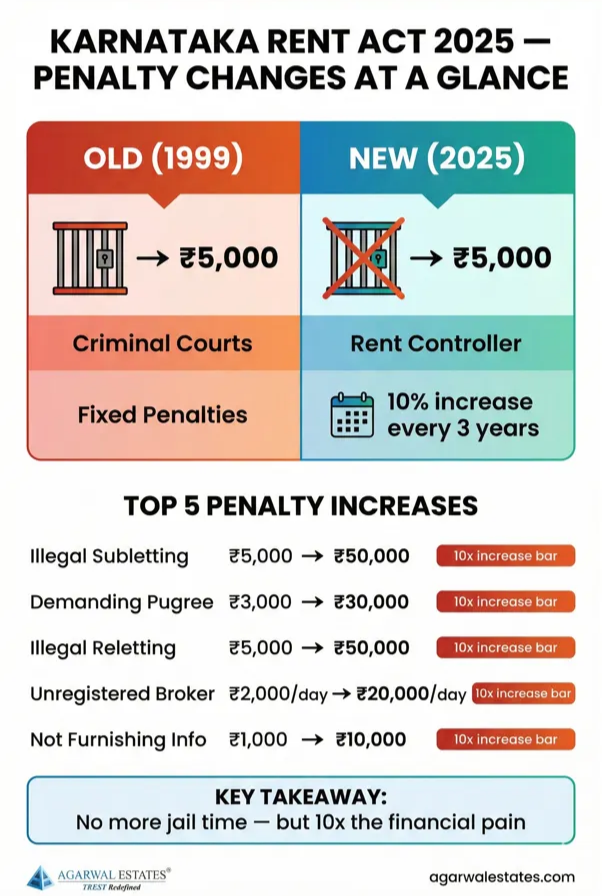
Karnataka Rent Act 2025 Penalties: Complete Section 54 Breakdown
Section 54 is the heart of the penalty framework under the Karnataka Rent Act. The 2025 amendment restructures this entire section converting what was previously a single section into sub-section (1), and adding a new sub-section (2) for automatic penalty escalation. In every clause, imprisonment has been removed and monetary penalties have been significantly increased typically by a factor of 10x.
| Clause | Violation Type | Relevant Section | Old Penalty (1999 Act) | New Penalty (2025 Amendment) | Key Change |
|---|---|---|---|---|---|
| 54(i) | Failure to register lease agreement or furnish required particulars | Section 4(3)(a), 4(3)(b) | Fine up to ₹2,000 OR imprisonment up to 1 month OR both PLUS ₹500/day continuing default | Penalty up to ₹2,000 PLUS ₹5,000/day continuing default | Imprisonment removed; daily default penalty increased 10x (₹500 → ₹5,000) |
| 54(ii) | Claiming or receiving unlawful charges | Section 11 | Fine exceeding unlawful charges by ₹2,500 OR imprisonment up to 1 month OR both | Penalty exceeding unlawful charges by ₹20,000 | Imprisonment removed; excess penalty increased 8x (₹2,500 → ₹20,000) |
| 54(iii)(a) | Estate agent/middleman operating without registration | Section 20(1) | Fine up to ₹2,000 OR imprisonment up to 1 month OR both PLUS ₹2,000/day continuing default | Penalty up to ₹2,000 PLUS ₹20,000/day continuing default | Imprisonment removed; daily default penalty increased 10x (₹2,000 → ₹20,000) |
| 54(iii)(b) | Estate agent failing to submit required statements | Section 21(1) | Fine up to ₹1,000 OR imprisonment up to 1 month OR both PLUS ₹200/day continuing default | Penalty up to ₹1,000 PLUS ₹2,000/day continuing default | Imprisonment removed; daily default penalty increased 10x (₹200 → ₹2,000) |
| 54(iii)(c) | Estate agent failing to file returns | Section 21(2) | Fine up to ₹2,000 OR imprisonment up to 1 month OR both PLUS ₹200/day continuing default | Penalty up to ₹2,000 PLUS ₹2,000/day continuing default | Imprisonment removed; daily default penalty increased 10x (₹200 → ₹2,000) |
| 54(iv) | Tenant illegally subletting or parting with possession | Section 27(2)(b) | Fine up to ₹5,000 OR double rent received monthly OR imprisonment up to 1 month OR both | Penalty up to ₹50,000 OR double rent received monthly, whichever is more | Imprisonment removed; maximum penalty increased 10x (₹5,000 → ₹50,000) |
| 54(v) | Landlord making false statement in affidavit | Section 27, Explanation I, item (i) | Fine up to ₹5,000 OR double rent receivable for 3 months (if relet) OR imprisonment up to 1 month OR both | Penalty up to ₹50,000 OR double rent receivable for 3 months (if relet), whichever is more | Imprisonment removed; maximum penalty increased 10x (₹5,000 → ₹50,000) |
| 54(vi) | Landlord demanding premium, pugree, or other consideration | Section 32(2) | Fine up to ₹3,000 OR imprisonment up to 1 month OR both | Penalty up to ₹30,000 | Imprisonment removed; penalty increased 10x (₹3,000 → ₹30,000) |
| 54(vii) | Landlord illegally reletting premises | Section 35(1) | Fine up to ₹5,000 OR double rent received after reletting OR imprisonment up to 1 month OR both | Penalty up to ₹50,000 OR double rent received after reletting, whichever is more | Imprisonment removed; maximum penalty increased 10x (₹5,000 → ₹50,000) |
| 54(viii) | Tenant failing to re-enter after repairs without reasonable excuse | Section 36(2) | Fine equivalent to 3 months’ rent | No change — Fine equivalent to 3 months’ rent | This clause was not amended |
| 54(ix) | Cutting off or withholding essential services | Section 49(1) | Fine equivalent to 3 months’ rent OR imprisonment up to 1 month OR both PLUS ₹100/day continuing default | Fine equivalent to 3 months’ rent PLUS ₹1,000/day continuing default | Imprisonment removed; daily default penalty increased 10x (₹100 → ₹1,000) |
| 54(x) | Failure to furnish particulars as required | Section 52 | Fine up to ₹1,000 OR imprisonment up to 1 month OR both | Penalty up to ₹10,000 | Imprisonment removed; penalty increased 10x (₹1,000 → ₹10,000) |
New Provision: Automatic Penalty Escalation Every 3 Years
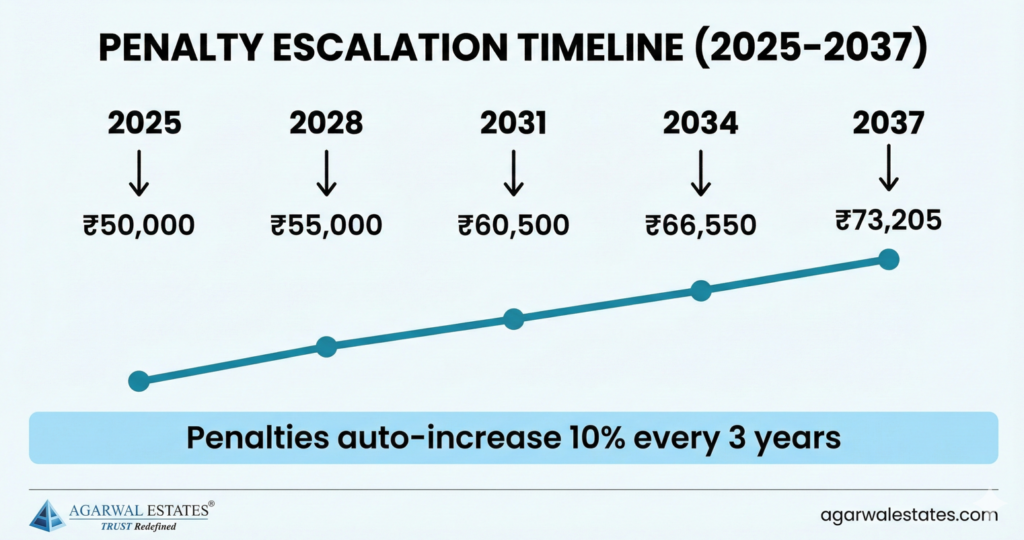
One of the most forward-looking aspects of the 2025 amendment is the introduction of automatic penalty increases under the newly inserted Section 54(2). This means the Karnataka Rent Act 2025 penalties are not frozen at their current levels they will grow over time.
The provision states: penalties shall be increased by ten percent of the minimum penalty amount after the expiry of every three years from the date of commencement of the Karnataka Rent (Amendment) Act, 2025.
The table below projects how penalties will grow, using the ₹50,000 maximum as an example:
| Year | Penalty Amount | Increase from Base |
|---|---|---|
| 2025 (Base) | ₹50,000 | — |
| 2028 | ₹55,000 | +10% |
| 2031 | ₹60,500 | +21% |
| 2034 | ₹66,550 | +33% |
| 2037 | ₹73,205 | +46% |
Note: The exact calculation methodology will be clarified through government rules. The projection above assumes compounding on the minimum penalty amount.
Structural Changes Beyond Penalties
Section 53: Complete Removal
Section 53 of the original Act which gave criminal courts cognizance over rental violations has been entirely omitted. The criminal prosecution route no longer exists for rental violations under the Karnataka Rent Act. All enforcement now flows through the Rent Controller.
Section 24: Enhanced Controller Powers
The amendment inserts a new sub-section (1-A) in Section 24, explicitly empowering the Rent Controller to act as an adjudicating officer for the purpose of determining penalties under Section 54. This eliminates the need to route cases through criminal courts, enables faster resolution, and creates a more streamlined administrative enforcement mechanism.
Section 55: Terminology Overhaul
Section 55, which deals with violations by corporate entities, has been comprehensively reworded to reflect the shift from criminal to civil enforcement. Every reference to “offence,” “punishment,” and “guilty” has been replaced with “contravention,” “penalty,” and “liable to pay.” The Explanation defining “company” and “director” remains unchanged.
What This Means in Practice: Stakeholder Exposure
The tables below translate the legal changes into practical exposure for different stakeholders.
For Landlords
| Violation | Old Maximum Exposure | New Maximum Exposure | Risk Multiplier |
|---|---|---|---|
| Not registering lease agreement | Jail + ₹2,000 + ₹500/day | ₹2,000 + ₹5,000/day | Daily penalty 10x higher |
| Demanding pugree/premium | Jail + ₹3,000 | ₹30,000 | 10x penalty |
| Illegal reletting | Jail + ₹5,000 or 2x rent | ₹50,000 or 2x rent | 10x max penalty |
| False affidavit (eviction) | Jail + ₹5,000 or 2x 3-month rent | ₹50,000 or 2x 3-month rent | 10x max penalty |
| Cutting essential services | Jail + 3-month rent + ₹100/day | 3-month rent + ₹1,000/day | Daily penalty 10x higher |
| Not furnishing particulars | Jail + ₹1,000 | ₹10,000 | 10x penalty |
For Tenants
| Violation | Old Maximum Exposure | New Maximum Exposure | Risk Multiplier |
|---|---|---|---|
| Illegal subletting | Jail + ₹5,000 or 2x rent/month | ₹50,000 or 2x rent/month | 10x max penalty |
| Not registering lease | Jail + ₹2,000 + ₹500/day | ₹2,000 + ₹5,000/day | Daily penalty 10x higher |
| Cutting essential services | Jail + 3-month rent + ₹100/day | 3-month rent + ₹1,000/day | Daily penalty 10x higher |
| Not furnishing particulars | Jail + ₹1,000 | ₹10,000 | 10x penalty |
For Estate Agents and Middlemen
Estate agents face some of the steepest increases in daily default penalties under the new Karnataka Rent Act penalty framework, making continued non-compliance extremely costly.
| Violation | Old Maximum Exposure | New Maximum Exposure | Risk Multiplier |
|---|---|---|---|
| Operating without registration | Jail + ₹2,000 + ₹2,000/day | ₹2,000 + ₹20,000/day | Daily penalty 10x higher |
| Not submitting statements | Jail + ₹1,000 + ₹200/day | ₹1,000 + ₹2,000/day | Daily penalty 10x higher |
| Not filing returns | Jail + ₹2,000 + ₹200/day | ₹2,000 + ₹2,000/day | Daily penalty 10x higher |
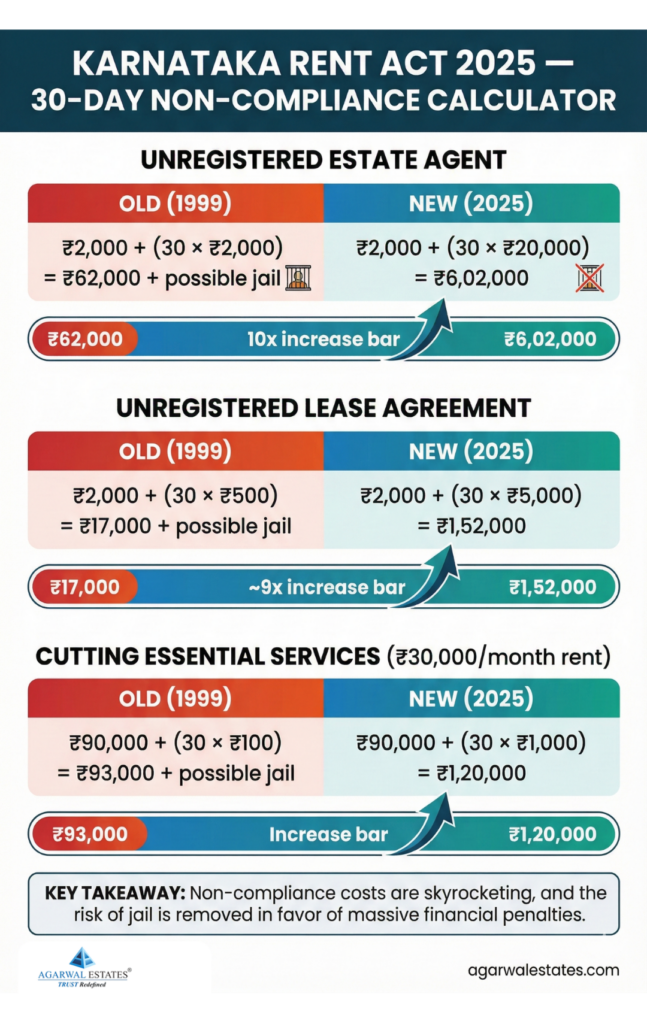
Example calculation: An unregistered estate agent who continues operating for 30 days after being noticed would face:
- Old regime: Up to ₹2,000 + (30 × ₹2,000) = ₹62,000 maximum, plus potential imprisonment
- New regime: Up to ₹2,000 + (30 × ₹20,000) = ₹6,02,000 maximum, no imprisonment
What Has Not Changed
It’s equally important to understand what the amendment does not alter. The substantive rights and protections under the Karnataka Rent Act, 1999 remain fully intact:
- Grounds for eviction — All existing grounds under Section 27 remain unchanged
- Tenant protection principles — No dilution of tenant rights
- Rent fixation and revision mechanisms — Standard rent determination process unchanged
- Security deposit norms — Limits and rules for deposits remain the same
- Inheritability of tenancy — Succession rights continue as before
- Fair rent provisions — Calculation methodology unchanged
- Essential services definition — What constitutes essential services remains the same
- Controller’s other powers — Inspection, inquiry, and documentation powers under Section 24(1) and (2) remain intact
When Do the New Karnataka Rent Act 2025 Penalties Apply?
The amendment’s commencement clause is unambiguous it comes into force immediately upon gazette notification, with no delayed or phased implementation and no grace period specified. Violations occurring after commencement attract the new penalties.
Unlike the original Karnataka Rent Act, 1999 which allowed different provisions to be brought into force on different dates the 2025 amendment has no such provision. Everything applies together, at once.
Legislative Context: Why This Amendment?
The Statement of Objects and Reasons in the Bill explains that the amendment is intended to achieve “Minimum Government Maximum Governance” by decriminalising minor offences and rationalising monetary penalties, in line with the Jan Vishwas (Amendment of Provisions) Act, 2023 (Central Act 18 of 2023). This aligns Karnataka with the Central Government’s broader national decriminalisation initiative, which aims to:
- Reduce burden on criminal courts
- Remove imprisonment for procedural and minor violations
- Shift to penalty-based compliance frameworks
- Enhance ease of doing business and ease of living
For more on the broader legislative context, see the Karnataka Legislature official website.
Impact on Bangalore’s Rental Market
Bangalore India’s third-largest rental market will feel the effects of these revised Karnataka Rent Act 2025 penalties acutely. With over 30–35 lakh rental households and average rents of ₹25,000–₹50,000 per month for 2–3 BHK apartments, the financial exposure under the new regime is substantial.
Common Bangalore Practices and Their New Penalty Risk
| Common Bangalore Practice | Relevant Clause | New Penalty Risk |
|---|---|---|
| Unregistered rental agreements (very common) | 54(i) | ₹2,000 + ₹5,000/day |
| Brokers operating without registration | 54(iii)(a) | ₹2,000 + ₹20,000/day |
| “Token” or “booking amount” beyond deposit | 54(vi) | Up to ₹30,000 |
| Lock-outs over rent disputes | 54(ix) | 3-month rent + ₹1,000/day |
| Unauthorized subletting in IT corridors | 54(iv) | ₹50,000 or 2x rent |
What Bangalore Landlords Should Do Now
- Register all existing agreements — The ₹5,000/day penalty for unregistered agreements makes this urgent
- Audit subletting arrangements — Common in areas like Whitefield, Marathahalli, Electronic City
- Document all charges — Any amount beyond rent and permitted deposit could trigger Section 11 violations
- Review broker relationships — Ensure your agent is registered under Section 20
What Bangalore Tenants Should Know
- Insist on registered agreements — You’re equally liable for non-registration
- Keep all payment records — Essential if disputing unlawful charges under Section 11
- Document essential services — Photos and timestamps if services are cut off
- Check broker registration — Unregistered brokers cannot legally facilitate your lease
Frequently Asked Questions
Is imprisonment completely eliminated under the Karnataka Rent Act 2025 penalties?
Yes, for all violations under Section 54. The amendment systematically replaces criminal punishment (fine and/or imprisonment) with civil monetary penalties. Section 53, which provided the criminal prosecution route, has been entirely omitted.
Are the new penalties retrospective?
The amendment does not explicitly address retrospectivity. Standard legal principles suggest it applies to violations occurring after commencement, not to past conduct already adjudicated.
Who imposes penalties now?
The Rent Controller, exercising powers as “adjudicating officer” under the newly inserted Section 24(1-A).
Can penalties be appealed?
The amendment does not alter the existing appeal mechanism. Appeals from Controller’s orders continue to lie before the Rent Tribunal under Section 43 of the principal Act.
What happens to pending criminal cases under the old Act?
The amendment is silent on transition provisions for ongoing prosecutions. This may require clarification through government notification or judicial interpretation.
How is the 10% escalation in the Karnataka Rent Act 2025 penalties calculated?
The exact methodology will be prescribed through rules. The provision states it applies to “the minimum amount of penalty” every three years from the date of commencement of the amendment.
The Bottom Line
The Karnataka Rent Act 2025 penalties represent a fundamental shift in enforcement philosophy. Criminal prosecution, imprisonment, and modest fines are out. Administrative adjudication, substantially higher financial penalties, faster enforcement, and automatic escalation are in.
For landlords, tenants, and estate agents operating in Karnataka, the cost of non-compliance has increased dramatically often by a factor of 10x even as the threat of imprisonment has been removed. Documentation, registration, and transparency are now financially imperative, not just legally advisable.
The message is clear: compliance is no longer optional, and while you won’t go to jail, your wallet will feel the pain.
This article is for informational purposes only and does not constitute legal advice. For specific guidance on compliance with the Karnataka Rent Act and its amendments, consult a qualified legal professional.