
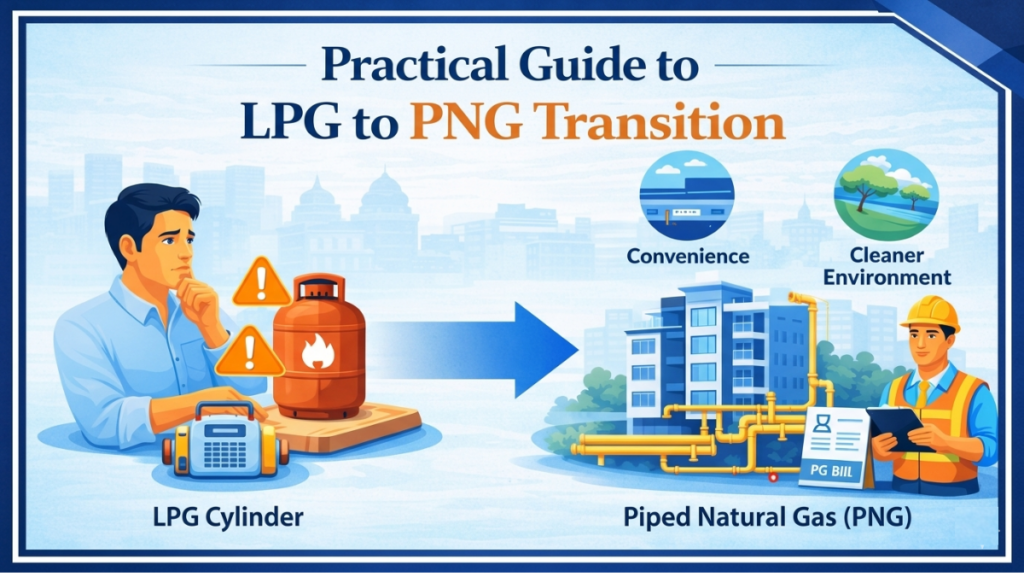
In urban residential communities, access to essential utilities such as cooking gas is undergoing a significant transformation driven by infrastructure expansion and policy direction. One of the key developments is the gradual transition highlighted in the LPG vs PNG discussion, as more households move from LPG (Liquefied Petroleum Gas) to PNG (Piped Natural Gas) in areas where pipeline connectivity is available.
This transition is being actively encouraged by the Ministry of Petroleum and Natural Gas to enhance safety standards, improve efficiency, and provide greater convenience in gas distribution systems.
To help residents clearly understand this shift and take informed action, this practical guide has been developed as part of our K.E.Y. (Knowledge Empowers You) Series.
📄 1. Understanding the Policy Shift from LPG to PNG
The government is steadily promoting PNG adoption in urban areas where pipeline infrastructure has been established under City Gas Distribution (CGD) networks.
As per current policy direction and implementation trends:
- Households located in PNG-enabled areas are being encouraged and in some cases nudged to transition from LPG
- Continued reliance on LPG in such regions may face gradual limitations over time
- LPG supply will continue to remain available in areas where PNG infrastructure is not feasible or still under development
This transition aligns with India’s broader goal of building a more reliable, efficient, and modern urban energy ecosystem while reducing dependence on cylinder-based logistics.
🔍 2. What Is PNG and How It Differs from LPG
PNG (Piped Natural Gas) is delivered directly to households through a fixed underground pipeline network, unlike LPG, which is supplied in portable cylinders.
Key differences include:
- PNG offers uninterrupted supply without the need for booking or refilling
- LPG requires periodic cylinder replacement and delivery coordination
- PNG operates at relatively lower pressure, enhancing operational safety
- LPG involves storage, handling, and manual replacement of cylinders
Understanding the difference between LPG and PNG allows residents to evaluate the transition from both a practical and safety perspective.
✅ 3. Benefits of Switching to PNG
Residents in societies where PNG is available can experience multiple advantages:
Continuous Supply
PNG ensures uninterrupted access, eliminating the need to track cylinder levels
Convenience
Gas is available instantly through a pipeline, similar to water or electricity
Improved Safety
Lower pressure systems and faster dispersion characteristics reduce potential risks
Transparent Billing
Meter-based billing provides clarity and control over monthly consumption
Space Optimization
No need to allocate storage space for bulky cylinders
💰 4. Cost Considerations: PNG vs LPG
Cost plays a crucial role in decision-making for most households.
- PNG is generally more cost-efficient over long-term usage
- LPG prices may fluctuate due to market conditions and subsidy changes
- PNG provides predictable, utility-style monthly billing
However, residents should also consider:
- One-time installation and connection charges
- Security deposits (RS.4500)
- Readiness of society-level infrastructure
A long-term perspective often reveals better value with PNG, especially for regular users.
🏢 5. Implications for Apartment and Gated Communities
For residents in apartments and gated societies, the transition is often coordinated at a community level:
- Many modern developments are pre-equipped with PNG pipeline systems
- Resident Welfare Associations (RWAs) may recommend or standardize PNG usage
- Builders are increasingly integrating PNG infrastructure into new projects
Residents should consult society management to understand:
- Availability status
- Installation timelines
- Any internal guidelines or mandates
⚠️ 6. Will LPG Be Discontinued Completely?
LPG is not being completely phased out.
However:
- Its usage may gradually decline in urban areas with established PNG networks
- Policy direction clearly favors PNG as the preferred long-term solution
- LPG will continue to serve regions without PNG connectivity
Residents should consider this as a phased transition rather than an immediate replacement.
📥 7. PNG Gas Connection – Steps for Individual Application
For residents wondering how can I get a new gas pipeline connection? What should I do to make the process easier? The process is straightforward and can be completed online.
a) Register Online
Apply through the official portal:
https://customer.gailgaspng.com/Home/CustomerRegistration_BeforeLogin
Upload the required documents:
Proof of Identity (any one in the name of the owner):
- Aadhaar Card
- PAN Card
- Passport
- Voter ID Card
- Driving License
- Ration Card
Proof of Ownership / Address (any one mentioning property address):
- Aadhaar Card
- Copy of Sale Deed Agreement (Pages 1 & 2 and Schedule-C page)
- Electricity Bill
- Passport
- BSNL Telephone Bill
- Society Certificate
⚠️ Important: Ensure all required documents are properly attached during registration. Incomplete applications may be rejected.
For more details:
https://gailgas.com/home
b) BP Number Generation
After successful document verification by GAIL Gas Limited, a BP (Business Partner) Number is generated.
c) Installation of Connection
Once approved, the pipeline connection and gas meter are installed at your residence.
d) Security Deposit Payment
Pay online:
https://customer.gailgaspng.com/online/billpay
e) Activation (Gas-In)
Book your slot:
https://customer.gailgaspng.com/Online/CustomerSlotBooking
f) Billing & Payments
Bills are generated once every two months based on actual usage
g) Post-Registration Requirement (For Society Records)
Share:
- BP Number
- Flat Number
- Owner Name
📧 Email: cce.pfs@gmail.co
h) Support & Assistance:
Use PNG MITRA App or call:
📞 1800-102-9282
📍 8. Checking PNG Availability in Your Area
Before making a decision, residents should verify availability through:
- Society management or RWA
- Local authorized gas distribution companies
- Physical indicators such as existing pipeline infrastructure
⏳ 9. Why Early Action Is Recommended
With growing policy focus on PNG adoption:
- Demand for new connections is expected to increase
- Installation timelines may extend due to high volume
- Societies may introduce deadlines for mandatory transition
⚠️ Early registration ensures smoother processing and uninterrupted gas access.
📘 Summary
The shift from LPG to PNG marks a major advancement in urban utility services in India.
PNG offers key advantages, including continuous supply, enhanced safety, operational convenience, and improved cost predictability. While LPG will remain relevant in areas without pipeline access, residents in PNG-enabled regions should prepare for a gradual and inevitable transition.
Being informed and proactive will ensure a seamless and hassle-free shift.
Disclaimer
The information provided in this purposes only and should not be considered as legal or regulatory advice. Policies, implementation timelines, and applicability may vary depending on location and infrastructure readiness. Residents are advised to consult authorized gas distribution companies or official government sources for accurate and updated information.