
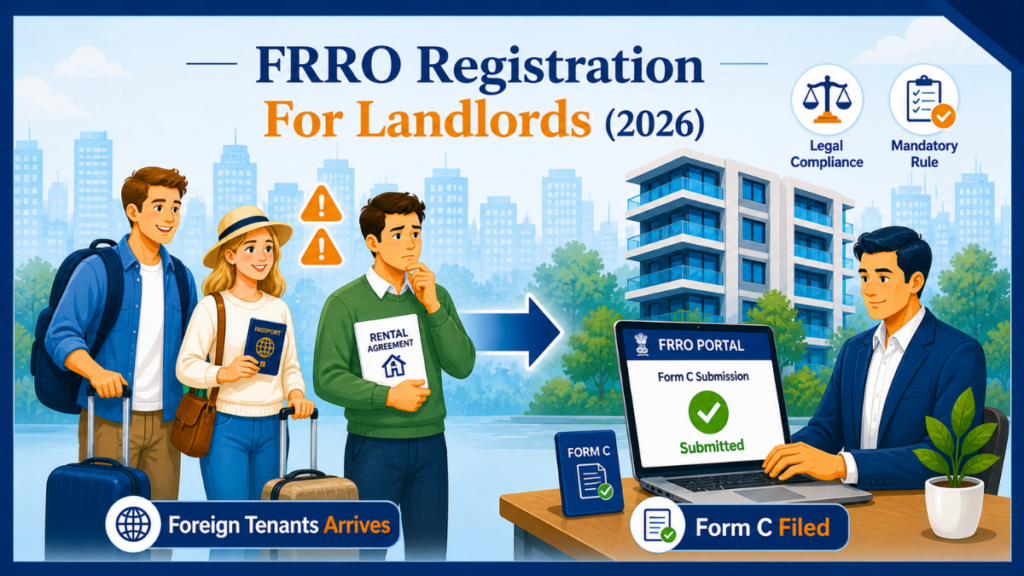
If you own a rental property in Bangalore and your tenant is a foreign national, compliance with FRRO online registration is a legal requirement that falls directly on you as the property owner. With Bangalore being one of India’s most active cities for expat professionals, IT workers, and international students, understanding your obligations is more important than ever.
What Is FRRO and Why Does It Matter to You?
FRRO stands for Foreigners’ Regional Registration Office. It operates under the Ministry of Home Affairs and is responsible for tracking the stay of foreign nationals across India. Bangalore has a dedicated FRRO office, and all foreign tenant compliance in the city is handled through it.
India’s immigration framework underwent a major transformation with the introduction of the Immigration and Foreigners Act, 2025, which came into effect on September 1, 2025. This new law replaced four earlier statutes, including the Foreigners Act, 1946, and the Registration of Foreigners Act, 1939.
For landlords, the most important outcome of this change is that the form you are required to file is widely known as Form C (officially called Form-III under the new Act). Throughout this guide, we use Form C consistently, as it remains the term most landlords are familiar with.
What Is Form C and Who Must File It?
Form C is a compulsory report that must be submitted to the Foreigners Regional Registration Office (FRRO) or Foreigners Registration Office (FRO) whenever a foreign national resides at a property in India. The requirement stems from Section 8 of the Immigration and Foreigners Act, 2025, which mandates that every person or entity that provides accommodation to a foreigner must furnish details of their stay.
Two things every Bangalore landlord must be absolutely clear on:
The obligation to submit Form C applies regardless of whether the accommodation is provided for payment or as a courtesy. The law does not exempt informal or non-commercial arrangements from this requirement.
Form C must be submitted by the host or accommodation provider. Foreign nationals cannot submit this form on their own behalf. The individual or establishment providing the accommodation is legally obligated to complete and submit the form.
The 2025 Update Every Landlord Must Know: OCI Card Holders Are Now Included
This is a significant change that caught many landlords off guard.
Following the enactment of the Immigration and Foreigners Act, 2025, in September 2025, the FRRO has made it mandatory for Form C registration to apply to OCI cardholders as well. Accordingly, accommodation providers are now required to submit Form C details for OCI holders in the same manner as for other foreign nationals.
If your tenant holds an OCI card, you are still required to file Form C. The previous exemption no longer applies for accommodation reporting purposes.
The 24-Hour Deadline: What It Means and When It Starts
Form C must be submitted within 24 hours of a foreign national’s arrival. It alerts local authorities to the foreigner’s presence.
The clock starts when your tenant physically moves into the property, not on the date the rental agreement was signed. These are often two different dates, and this distinction matters. Always file based on the actual move-in day.
Even if a guest arrives and leaves on the same day, their stay must still be documented through Form C. There is no minimum duration of stay that exempts this requirement.
You Must File at Check-Out Too — Not Just at Check-In
This is the most commonly missed obligation among private landlords in Bangalore.
The Ministry of Home Affairs in India, through the Bureau of Immigration and the local Foreigners Regional Registration Offices, requires landlords of privately owned residences to update the departure or check-out dates for foreign national guests and tenants via the Online Portal Form C.
Form C is required to be submitted within 24 hours of a foreign guest’s arrival. While there is currently no explicit timing for submission of Form C upon check-out, submitting within 24 hours of check-out is advisable.
In practice: file once when your tenant moves in, and file again when they vacate.
What Happens When Landlords Don’t Comply: Real Cases from Bangalore
These are not hypothetical warnings. Bangalore police have actively prosecuted landlords who failed to meet their Form C obligations. The following cases, reported across 2025 and 2026, illustrate exactly what non-compliance looks like and what it costs.
The Chudasandra Rescue Case (August 2025)
In late August 2025, the Central Crime Branch (CCB) conducted a raid on a residential property in Chudasandra and found two Ugandan women living there without proper documentation. The homeowner had rented the property without filing the required Form C and without notifying authorities. A case was registered under the Foreigners Act, and the homeowner went absconding. Bengaluru’s Police Commissioner issued a public statement in the aftermath, urging all landlords to follow their legal obligations: the homeowner had not submitted Form C and had not informed the police, and action would be taken against both landlord and tenant in similar situations going forward.
Case Details:
North East Division: 23 Landlords Charged at Once (September 2025)
The scale of enforcement became clearer in September 2025, when Bengaluru’s North East Division police filed cases against 23 house owners in a single crackdown. These landlords had rented properties to foreign nationals without obtaining the required documents, and in several instances, foreign tenants were found to be living in the city even after their visas had expired. Violations were recorded across multiple police station limits, including Yelahanka, Kothanur, Kodigehalli, Chikkajala, Amruthahalli, Bagalur, Sampigehalli, and Vidyaranyapura. By March 2025, police records showed that at least 70 such cases had been registered in Bangalore; overall, 42 were under trial, 26 under investigation, and one conviction had already been secured.
Case Details:
Consequences of Non-Compliance
No fixed penalty amount for landlords is codified in publicly available official rules under the current Act. What is confirmed is the following.
Failure to comply with Form C rules can result in fines and penalties as determined by the designated Registration Officer, flagging of the accommodation provider for audit, inspection, or potential blacklisting, complications for the foreign national in obtaining visa extensions or during departure formalities, and legal action in cases of serious or repeated non-compliance.
Any blog or source quoting a fixed penalty figure specifically for landlords should be treated with caution, as this figure is not officially stated in the law.
Documents Required for FRRO Online Registration as a Landlord
Before filing Form C for the first time, you need to register yourself as a host on the FRRO portal. For private landlords renting individual apartments or houses:
Hosts who accommodate foreign guests in their individual houses or apartments do not need to submit a B&B license to register with the FRRO. Such hosts may simply submit their address proof to activate registration.
For individual hosts, the documents typically required include utility bills, property tax receipts, sale deed or rent agreement, and registration forms.
For each Form C submission at check-in, you will need your tenant’s passport details, visa details, a clearly signed rental agreement, and your address or ownership proof if requested by the local office.
Step-by-Step: How to File Form C as a Landlord
Step 1: Register as a host. Go to FRRO online registration login : https://indianfrro.gov.in/frro/FormC and create your host account. This is a one-time step.
Step 2: Activate your registration. Once the host completes the FRRO online registration by submitting the form and supporting documents, subsequent Form C submissions may be made online. Depending on the Bangalore FRRO office’s current requirements, you may need to submit supporting documents in person or by post to activate your account.
Step 3: File at check-in. Within 24 hours of your tenant moving in, log in, fill in their details accurately, upload a clear and signed rental agreement, and submit.
Step 4: Save your acknowledgment receipt. After submission, save the acknowledgment receipt. It may be requested by immigration or police authorities, especially in the case of a compliance check.
Step 5: File at check-out. When your tenant vacates, log back into the same portal and update the departure details.
What Happens If You Cannot File Online?
If a host does not have internet connectivity, they should call up and inform the FRRO office or the local Superintendent of Police. Lack of internet connectivity is not an acceptable excuse for failing to report a foreign guest when alternative reporting options exist.
If there is no accessible FRRO office, hosts should submit Form C to the local Superintendent of Police and not to the local police station.
Your Obligations vs. Your Tenant’s Obligations
These are two completely separate legal requirements and should not be confused.
Your duty as a landlord is to file Form C within 24 hours of check-in and again at check-out. This applies to every foreign national, including OCI cardholders, regardless of their visa type or length of stay.
The tenant’s separate obligation involves their own personal FRRO registration. FRRO registration with the FRO is mandatory for foreign nationals within 14 days from their date of arrival in India if their visa is valid for longer than 180 days or if the visa stamp specifically requires this registration.
Your Form C filing exists independently of whether the tenant is required to complete their own registration or not.
Common Mistakes Bangalore Landlords Make
- Submitting based on the agreement date instead of the move-in date – Always file according to when the tenant actually takes possession.
- Failing to report the check-out – The responsibility doesn’t end at check-in — update the tenant’s departure on the portal once they leave.
- Not registering as a host before filing – You must activate your host account on the portal before submitting Form C, so complete this step in advance.
- Assuming OCI cardholders are exempt – They are not, as of September 2025.
- Uploading unclear documents – A blurry or unsigned rental agreement is one of the most common reasons the FRRO raises a query, so always upload a clean, fully signed copy.
- Ignoring FRRO queries – If a query is raised against your submission, respond promptly, as unresolved queries can leave the filing in a pending state and create complications for your tenant during visa renewals and exit formalities.
Also, Maintain Form B at Your Property
Apart from submitting Form C for foreign guests, hosts must also keep separate records for Indian and foreign guests, now called Form B (earlier Form F), with details of every guest. This is a physical register maintained at the property, separate from online submissions, and it must be available for inspection by authorities when required.
Quick Reference Links
Form C Filing Portal: https://indianfrro.gov.in/frro/FormC
e-FRRO Main Portal: https://indianfrro.gov.in/eservices/
Login and Application Status: https://indianfrro.gov.in/eservices/home.jsp
Frequently Asked Questions
Do I need to file even if my tenant stays for just a few days?
Yes, the duration of stay does not exempt the host from reporting obligations. Even if a guest checks in and leaves the same day, their stay must still be recorded through Form C.
Can my property manager file on my behalf?
Yes, the legal obligation rests on the accommodation provider, but an authorised representative can complete the filing. Make sure they are aware of the 24-hour check-in deadline and the check-out filing requirement.
What if my tenant and I disagree on the move-in date?
The relevant date is when the tenant physically occupies the property. Keep written communication or a move-in acknowledgment to establish this clearly.
Do I need to file again if the tenant renews their tenancy?
A straightforward renewal with the same tenant in the same property generally does not require a new Form C. However, if the tenant temporarily vacates and returns, that constitutes a new check-in, and a fresh filing is required. When in doubt, confirm with your local Bangalore FRRO office.
How Do I Check My FRRO Application Status?
To check your FRRO application status, visit the official portal at indianfrro.gov.in/eservices/home.jsp, log in with your registered credentials, and your application status will be displayed on the dashboard.
Conclusion:
FRRO compliance for Bangalore landlords is straightforward once you understand the basics. Here’s a quick summary of what you need to do:
- Register as a host on the FRRO portal at indianfrro.gov.in/frro/FormC.
- File Form C within 24 hours of your foreign tenant moving in.
- File again at check-out when your tenant vacates the property.
- Keep your rental agreement clean, complete, and signed.
- Respond promptly to any queries raised by the FRRO.
- Maintain your Form B register at the property for inspection.
As the cases above show, Bangalore’s enforcement is real and ongoing. Dozens of landlords have already faced criminal cases not because they were bad actors, but because they were unaware of their obligations or assumed the responsibility fell on their tenants. It does not. Staying on top of these obligations protects you legally and establishes your credibility as a responsible landlord.
Disclaimer: This article is intended for general informational purposes only and is based on publicly available information, compiled to the best of our knowledge and understanding. While Agarwal Estates strives to provide accurate and up-to-date insights, we do not guarantee the completeness, reliability, or accuracy of the information and do not accept any liability for any errors, omissions, or outcomes arising from its use. Readers are advised to independently verify applicable rules and regulations through official government sources or seek professional advice specific to their situation.