
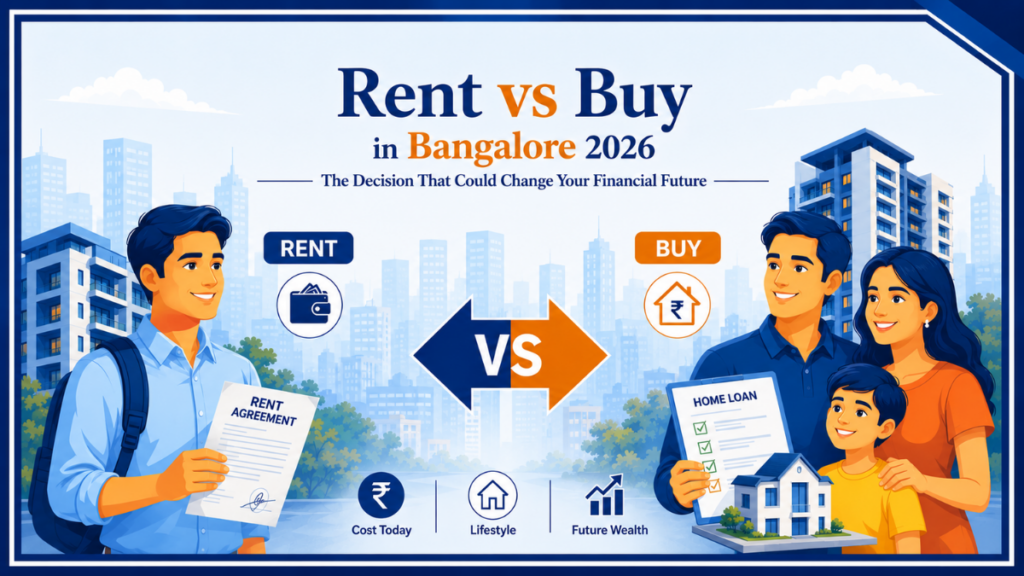
If you are living in Bangalore right now, the rent vs buy question is probably keeping you up at night. With property prices climbing sharply, home loan rates above 8.5%, and rental demand surging across every IT corridor, the stakes of getting this wrong are real. This is a data-backed look at what the rent vs buy equation actually looks like in Bangalore in 2026 with verified numbers, real localities, and clear scenarios.
What Does the Bangalore Real Estate Market Look Like in 2026?
Bangalore’s average asking price has climbed from ₹10,653 per sq ft in June 2025 to ₹12,119 per sq ft by March 2026. Government registration data from May 2025 to April 2026 recorded 15,778 transactions totalling ₹14,134 crore, confirming this is real buyer activity, not just listed prices. Understanding these numbers is the starting point of any honest rent vs buy analysis in Bangalore.
| Locality | Avg. Price Per Sq Ft (2026) | Avg. Monthly Rent (2BHK) | Rental Yield |
| Whitefield | ₹12,100 – ₹14,200 | ₹28,000 – ₹42,000 | ~3% |
| Sarjapur Road | ₹11,750 – ₹13,000 | ₹24,000 – ₹38,000 | 2% – 3% |
| HSR Layout (Sec 2) | ₹14,800 – ₹16,000 | ₹35,000 – ₹55,000 | ~2% |
| Electronic City | ₹5,000 – ₹7,500 | ₹14,000 – ₹22,000 | 3% – 3.8% |
| Hebbal / North Bangalore | ₹10,450 – ₹12,000 | ₹25,000 – ₹40,000 | 3% – 4% |
| Koramangala / Indiranagar | ₹15,000 – ₹20,000 | ₹45,000 – ₹80,000 | 3% – 3.5% |
| Bellandur | ₹15,400 | ₹30,000 – ₹48,000 | 3% – 3.5% |
| Devanahalli / Yelahanka | ₹6,000 – ₹7,000 | ₹15,000 – ₹22,000 | 3.5% – 4.5% |
Annual appreciation is projected at 6%–10% across most micro-markets, with North Bangalore and Sarjapur Road expected to lead.
Is Renting in Bangalore Still Worth It in 2026?
In the rent vs buy debate, renting clearly wins in specific situations.
- You are new to the city: Renting lets you test neighbourhoods before committing — commute quality between Whitefield and Marathahalli can only be understood by living there.
- Your job requires mobility: Professionals who may relocate every 2–3 years gain very little from a locked-in EMI.
- You don’t have a 20–25% down payment ready: Starting without ₹24–30 lakhs saved for a ₹1.2 crore flat puts you on a financially fragile footing.
- New inventory is entering the market: Bangalore recorded a 24% annual inventory rise in Q1 2026 – patient renters may find better deals in 12–18 months.
- You value liquidity: Surplus cash invested in SIPs or mutual funds can build parallel wealth while homeownership locks capital for years.
Quick numbers: A 2BHK in Whitefield at ₹32,000/month costs approximately ₹55 lakhs over 10 years (at 8% annual escalation) with zero equity built but full flexibility retained. For professionals still building their financial base, the rent vs buy calculation often tips towards renting.
Is Buying Property in Bangalore Worth It in 2026?
On the other side of the rent vs buy equation, buying holds a compelling case for the right buyer.
- Waiting has a cost: A ₹1.2 crore 2BHK at 8% appreciation reaches ₹1.75 crore by 2030; every year of delay is appreciation you don’t capture.
- Loan rates have stabilised: Most lenders offer 8.5%–9.25%, predictable enough for long-term EMI planning.
- RERA protects buyers: Completion timelines, fund usage, and builder accountability are now under regulatory oversight in Karnataka.
- Tax benefits are real: Section 24 (₹2 lakh on interest) and 80C (₹1.5 lakh on principal) can save ₹75,000–₹1 lakh annually for buyers in the 30% bracket.
- Stability matters: For families with school-going children or elderly parents, ownership provides what no rental agreement can.
Quick numbers: A ₹1.2 crore 2BHK in Sarjapur Road needs roughly ₹41–52 lakhs in year one (down payment + stamp duty + interiors). At 8% appreciation over 10 years, it grows to ₹2.59 crore, a gain of ₹1.39 crore. That kind of return makes the rent vs buy decision much clearer for long-term Bangalore residents.
Rent vs Buy: A Side-by-Side Comparison
| Factor | Renting | Buying |
| Monthly cash outflow | Lower | Higher (EMI + maintenance) |
| Flexibility | High | Low |
| Wealth creation | Indirect (via investments) | Direct (equity + appreciation) |
| Tax benefit | None | Section 24 & 80C deductions |
| Initial capital needed | Low (deposit only) | High (20–25% down + costs) |
| Stability | Low (landlord decisions) | High |
| Renovation freedom | None | Full |
| Ideal for | Early career, mobile professionals | Settled families, long-term planners |
Is Renting Cheaper Than Buying? The Price-to-Rent Ratio
Formula: Purchase Price ÷ Annual Rent = P/R Ratio. A ratio below 20 favours buying; above 30 favours renting.
| Locality | 2BHK Purchase Price | Annual Rent | P/R Ratio | Verdict |
| Electronic City | ₹65–75 lakhs | ₹2.04 lakhs | ~34 | Renting favourable |
| Devanahalli | ₹60–70 lakhs | ₹1.92 lakhs | ~34 | Renting favourable |
| Sarjapur Road | ₹95–110 lakhs | ₹3.24 lakhs | ~31 | Borderline |
| Whitefield | ₹1.1–1.3 crore | ₹3.84 lakhs | ~30 | Buy or Rent |
| HSR Layout | ₹1.5–1.8 crore | ₹5.4 lakhs | ~30 | Borderline |
| Koramangala | ₹2–2.5 crore | ₹7.2 lakhs | ~30 | Borderline |
Most Bangalore localities sit between P/R 29–34, a neutral zone where your personal financial readiness and life stage matter more than the ratio alone.
Which Areas Should You Consider?
Best areas for buying:
- Sarjapur Road: ORR tech parks, strong schools, metro expansion upcoming. ₹11,750–₹13,000/sq ft.
- Whitefield: East Bangalore’s IT hub, 24.1% YOY price growth. ₹12,100–₹14,200/sq ft.
- Hebbal / Thanisandra: Airport corridor, newer supply. ₹10,450–₹12,000/sq ft.
- Devanahalli: Lower entry point, long-term appreciation play. ₹6,000–₹7,000/sq ft.
Best areas for renting:
- Electronic City: Widest choice of property in Bangalore for rent at ₹14,000–₹22,000/month for a 2BHK.
- Marathahalli: Mid-range rents, easy ORR and Whitefield access.
- Bellandur / Hennur: Startup-friendly with growing Manyata Tech Park rental demand.
What Are the Hidden Costs Most People Overlook?
The rent vs buy decision looks very different once you see the full cost picture.
Renting: 8–10% annual rent escalation; security deposit of ~10 months locked in; brokerage at every renewal; no freedom to modify; eviction risk if landlord sells.
Buying: Stamp duty 5% (above ₹45L) + 1% registration; GST 5% on under-construction; loan processing fee 0.25%–1%; society maintenance ₹3–8/sq ft monthly; interior costs ₹10–25 lakhs; annual BBMP property tax; B-Khata risk in peripheral areas, always verify A-Khata before signing.
Who Should Buy a House in Bangalore Right Now?
Many people searching to buy houses in Bangalore in 2026 are already ready; they just need to confirm it. If the rent vs buy question has been lingering, use this checklist:
- Living in Bangalore for 5+ years with no relocation plans for 7–10 years
- EMI-to-income ratio comfortably below 40%
- ₹25–35 lakhs available as down payment and upfront costs not borrowed
- Family with school-going children who need neighbourhood stability
- Goal of building long-term wealth through real estate leverage
If none of these applies today, renting is not a failure; it is a financially disciplined waiting strategy.
How Agarwal Estates Helps You Make the Right Call
The rent vs buy decision becomes far less stressful with the right advisor. Founded in 2012 by Manoj Agarwal, bringing 10+ years in US leadership roles and 13+ years in real estate, Agarwal Estates was built to bring transparency to an industry that had very little of it.
They are ISO 9001:2015-certified and have served 10,000+ families, with a consistent 4.6 rating backed by 3,500 client reviews from 50+ countries. Their KEY (Knowledge Empowers You) program guides clients through every aspect of real estate, including buying, selling, renting, taxation, legal processes, property management, and investment decisions, before any commitment is made. They have even closed a buy/sale deed in just 18 calendar days, including registration, a process that routinely takes months elsewhere.
Services cover residential buying and selling, property management, commercial real estate, home loans, interior design, and allied services. Their ZeroChaos platform digitises registration end-to-end. Whether you are a first-time buyer, NRI investor, landlord, or business owner, Agarwal Estates guides you from first inquiry to final stamp.
Frequently Asked Questions (FAQs)
Still weighing the rent vs buy decision? Here are the questions Bangalore homebuyers ask most.
Q1. Is 2026 a good year to buy property in Bangalore?
Yes, prices are growing 6%–10% annually, and RERA offers strong buyer protection. Ensure your finances are genuinely ready first.
Q2. What is the average rent for a 2BHK in Bangalore in 2026?
Electronic City: ₹14,000–₹22,000/month. Whitefield: ₹28,000–₹42,000. Koramangala/Indiranagar: up to ₹80,000. City-wide average: ₹34/sq ft per month.
Q3. How much down payment do I need to buy a home in Bangalore?
Plan for 20–25% down payment plus ₹6–7 lakhs for stamp duty/registration and ₹10–20 lakhs for interiors, roughly ₹36–52 lakhs total for a ₹1 crore apartment.
Q4. What is the stamp duty for buying property in Bangalore in 2026?
5% stamp duty + 1% registration for properties above ₹45 lakhs approximately ₹6 lakhs on a ₹1 crore purchase.
Q5. Which areas offer the best rental yields in Bangalore?
HSR Layout Sector 3 (7.3%), Hennur Gardens (6.9%), and Dodda Nekkundi Extension (6.5%) lead in 2026.
Q6. Under-construction or ready-to-move, which is better?
Ready-to-move costs 10%–20% more but gives immediate possession and zero construction risk. Under-construction suits investors with a 3–5 year horizon.
Q7. What does the Price-to-Rent ratio tell me?
Bangalore’s P/R of 29–34 is a neutral zone, financial readiness and life stage drive the better answer more than the ratio itself.
Q8. Can I get property management support if I buy and rent out my flat?
Yes, firms like Agarwal Estates handle tenant sourcing, rent collection, lease documentation, and maintenance, built on 5,000+ rental transactions across Bangalore.
Disclaimer: This article is intended for general informational purposes only and is based on publicly available information, compiled to the best of our knowledge and understanding. While Agarwal Estates strives to provide accurate and up-to-date insights, we do not guarantee the completeness, reliability, or accuracy of the information and do not accept any liability for any errors, omissions, or outcomes arising from its use. Readers are advised to independently verify applicable rules and regulations through official government sources or seek professional advice specific to their situation.