
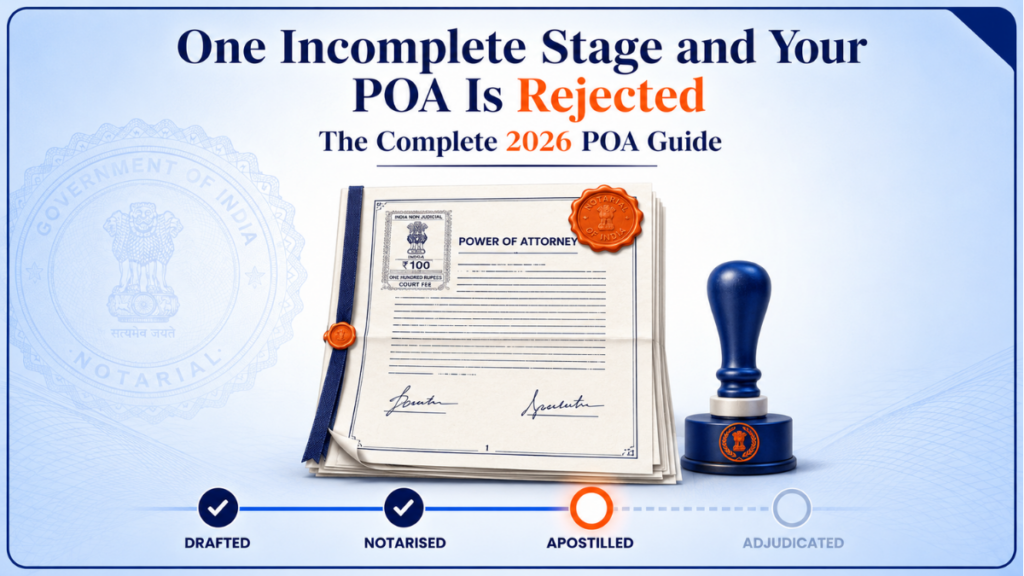
Need to buy, sell, or manage a property in India while you’re living abroad or in another city? A power of attorney for property registration can make this seamless, but only when it is drafted, notarised, registered, and adjudicated correctly. A small mistake at any one of these stages can lead to delays, extra costs, or even rejection at the Sub-Registrar’s office.
We’ve simplified the entire power of attorney process into one practical, legally grounded guide built on real transactions our team has personally handled, not generic internet advice.
What Is a Power of Attorney (POA)?
A Power of Attorney is a legal document through which a Principal (the Executant) appoints an Agent (the Attorney Holder) to act on their behalf in specific legal or financial matters. Two people are involved, and their roles cannot overlap:
- Principal (Executant) — the person granting the authority. The Principal must be careful while defining exactly what powers the Agent is allowed to exercise.
- Agent (Attorney Holder) — the person empowered to act. The Agent must act in the Principal’s best interest and strictly within the scope written into the POA.
There are two variants of this document:
- General Power of Attorney (GPA) — broader in scope
- Special Power of Attorney (SPA) — limited to a specific transaction, and this is the version recommended for buying or selling property.
One rule that’s often overlooked: in one POA, GPA, or SPA, only one Principal can appoint only one Attorney.
What Are the Steps to Execute a Power of Attorney for Property Registration?
A power of attorney for property registration becomes legally usable only after it passes through four sequential stages:
- Drafting: Prepared by a legal expert, with the complete address of the property, the Principal’s name, and the Attorney’s unique identification clearly stated. The original document is then handed over to the Attorney.
- Notarisation: The POA must be signed and executed in front of a certified notary officer.
- Apostilling: Required only if the POA is executed outside India (for example, by an NRI in the USA). Not required for a domestic POA. Once apostilled by the Authentication Division of the State Department, no further Embassy attestation is legally required, though it’s still commonly requested in practice.
- Registration and Adjudication: The POA is registered to authorise the Attorney to buy or sell immovable property, and Stamp Duty is paid and adjudicated at the jurisdictional District Registrar’s office. This is mandatory under the Indian Stamp Act.
How Does Power of Attorney for Sale of Property Work for Resident Indians?
If both the Principal and the Attorney live in India, here’s what the process looks like at the Sub-Registrar’s office:
- Both parties must be physically present together at the local Sub-Registrar’s office of the Principal’s jurisdiction.
- The POA must always be drafted in English. A POA drafted in another regional language, for instance, in Hindi in Rajasthan, may not be recognised as valid in Bangalore.
- Minimum Stamp Duty payable is Rs. 200/-, using e-Stamp paper from the Principal’s location.
- Both parties need two valid photo ID/address proof documents, each Aadhaar, PAN, Driving Licence, or Voter ID.
- Two witnesses are required, with valid photo ID/address proof.
- The Principal signs at the bottom of every page; the Attorney signs only on the final page.
- Adjudication is not required for a domestic POA.
Power of Attorney for NRI to Sell Property in India: Step-by-Step Process from the USA
This is where most of the confusion and the costliest mistakes happen. Here’s the documented, field-tested process for NRIs based in the USA.
A. Notarisation and Apostille in the USA
| Requirement | Detail |
| Paper | Plain white 8.5″x11″ (A4), 90–110 GSM |
| Signature rule | Executant signs at the bottom of every single page, with page numbers |
| Witnesses | Two, also notarised as part of the same process |
| Apostille | At the Secretary of State’s office; process varies by state |
| Embassy attestation | Optional but recommended for Indian Passport holders; not required for foreign nationals, US citizens, or OCI cardholders |
Supporting documents needed for authentication in the USA:
| Document | Notes |
| Original POA | Printed on A4, minimum 90 GSM |
| Passport | Self-attested previous and current passport; copy of first five and last two pages |
| Visa/EAD proof | Notarised copy of H1B/H4, I-94, Employment Authorisation Document, or Green Card |
| Address proof | Driving Licence, Utility Bill, or Landline Bill (mobile bills and bank statements are not accepted) |
B. Adjudication in India
Once the POA arrives in India duly notarised and apostilled, it must be adjudicated at the District Registrar’s Office (DRO) based on the property’s location not the Attorney Holder’s address, and not the Sub-Registrar.
Real example from our files: If the Attorney’s address proof is in Marathahalli, Bangalore, adjudication happens at the Shivaji Nagar DRO, not the Varthur or KR Puram Sub-Registrar’s office, because Marathahalli falls under Shivaji Nagar’s jurisdiction.
Documents required for adjudication:
| Document | Required From |
| Original POA + one copy | Attorney Holder |
| Application for Adjudication, duly signed | Attorney Holder |
| One passport-size photo | Attorney Holder |
| Two forms of self-attested photo ID/address proof | Both Principal and Attorney Holder |
| Sale Deed copy | Property |
| Property Tax paid receipt | Property |
| Encumbrance Certificate (EC) | Property |
| eKhata | Property |
Can a Person With Power of Attorney Sell Property in India?
Yes, but only within the exact scope defined in the POA document itself. This is precisely why a Special Power of Attorney (SPA), limited to the specific property transaction, is recommended over a General Power of Attorney for buying or selling. A few rules that govern this:
- The Attorney does not sign the original POA, and their photograph is not required in it, only in the Adjudication Application.
- The seller (Attorney) must hand over the original POA to the buyer at the time of sale; when the property is resold, the next buyer must receive that same original.
- Stamp duty depends on the relationship between Principal and Agent. Granting a POA to a blood relative keeps costs minimal; for non-blood relatives, stamp duty can run up to approximately 5% of the property’s prevailing guideline value.
Power of Attorney Costs and Timelines at a Glance
| Item | Cost / Timeline |
| Domestic POA stamp duty | Minimum Rs. 200/- |
| POA to non-blood relative | Up to ~5% of guideline value |
| Adjudication deadline (NRI POA) | Within 3 months of arrival in India |
| Adjudication processing time | Typically 1–3 days |
| Professional/legal fees | Rs. 10,000 – Rs. 25,000, depending on complexity |
| Dual Name Affidavit (India) | Rs. 50 stamp paper, notarised |
Real Cases From Our Files
These aren’t hypotheticals — they’re situations our team has personally navigated for clients.
Case 1: Adjudication in a Different City From the Property.
A client based in the USA owned property in Ghaziabad, but their attorney, Holder, lived in Bangalore. The Ghaziabad Registrar directed that adjudication be done in Bangalore. Junior staff at the Bangalore DRO initially said an out-of-city property couldn’t be adjudicated there, we escalated to the senior District Sub-Registrar, who approved it.
Takeaway: Always check with the Local/District Registrar in the POA Holder’s city of residence before booking travel.
Case 2: Name Discrepancy Across ID Documents
A POA Holder’s name appeared differently on their Aadhaar and PAN cards enough to stall registration, since the name on the POA must match the ID exactly. The fix was a Dual Name Affidavit, executed on Rs. 50 stamp paper in India (or on plain paper before a US Notary if the Principal is an NRI), declaring both names refer to the same person.
Case 3: Attestation at the Indian Embassy in Denmark.
Denmark doesn’t offer notarisation to non-Danish citizens, so the seller’s POA could only be attested at the Indian Embassy, which typically attests only the final page. To preserve document integrity without the prohibitive cost of per-page attestation, the Embassy laid all pages side by side and applied a single seal spanning every page at once.
Mistakes That Delay Power of Attorney–Based Property Registration
- Skipping page-by-page signatures: An unsigned page can get a POA questioned or rejected at the District Registrar’s office, forcing the entire USA-based process to be repeated.
- Assuming adjudication happens at the Sub-Registrar: It doesn’t. Only the District Registrar can adjudicate.
- Ignoring ID name mismatches: Even a minor spelling difference between Aadhaar and PAN can stall a transaction at the last mile.
- Treating Embassy attestation as mandatory: It’s optional for Indian citizens and not even applicable to OCI cardholders or foreign nationals.
- Missing the 3-month adjudication window: Adjudication must happen within three months of the POA’s arrival in India.
- Discovering an invalid POA after the sale deed is registered: This forces a Rectification Deed, an avoidable legal headache if the POA is verified upfront.
How Agarwal Estates Helps You Make Informed Power of Attorney Decisions
As an ISO 9001:2015 and CRISIL-certified real estate consultancy trusted by 10,000+ clients across Bangalore, Agarwal Estates put this guide together because we kept seeing misleading POA information online. Our team has personally coordinated NRI POA adjudications, resolved jurisdiction disputes between Registrar offices, and handled documentation gaps before they became deal-breakers, so when you work with us on a power of attorney for property registration, you’re getting guidance shaped by real transactions, not assumptions.
Frequently Asked Questions
Can adjudication be done at the POA holder’s home-city District Registrar (as per his KYC address) when the property is located in another city?
This is a grey area, and different Sub-Registrar offices interpret the rule differently. In our experience, adjudication is generally allowed in the POA holder’s KYC city, even when the property is located elsewhere, as long as the stamp duty applicable in the property’s city is paid. To avoid objections from the property’s city (which may follow a different stamp-duty rule), it is safer to use a slightly higher stamp amount (e.g., ₹200 required in Karnataka → take a ₹500 stamp). This ensures the POA remains valid across jurisdictions.
During adjudication, you must also submit:
• Sale deed copy
• Encumbrance Certificate (EC)
• Property tax paid receipt
• Self-attested KYC of both parties
• Original KYC document of the Attorney Holder
Can a person with power of attorney sell property in India?
Yes, but strictly within the powers defined in the POA document. A Special Power of Attorney limited to the specific sale transaction is recommended.
Is a power of attorney valid for selling a house if the Agent isn’t a blood relative?
Yes, it remains valid, but expect higher stamp duty, up to approximately 5% of the property’s guideline value, compared to the minimum of Rs. 200/- for blood relatives.
Do witnesses need to be notarised in the USA, too?
Yes, both witnesses must provide ID proof to the Notary and sign the POA as part of the same notarisation.
Is Indian Embassy attestation mandatory for an NRI’s Power of Attorney?
Not strictly, the law allows authentication by a Notary Public, Magistrate, or Indian Consul abroad, not embassy attestation specifically. In practice, though, many Sub-Registrars in India still prefer consular attestation for smoother property registration.
Does the Attorney sign the original POA?
No, the Attorney’s signature and photo appear only on the Adjudication Application, not the original POA.
What is the time limit for adjudicating an NRI’s POA in India?
It must be adjudicated within 3 months of the POA’s arrival in India.
In Bangalore, is adjudication done at the Sub-Registrar’s office?
No, Adjudication must be done at the District Registrar’s office (DRO), based on the Attorney’s address proof; a Sub-Registrar cannot adjudicate a POA.
Disclaimer: This article is intended for general informational purposes. While we’ve drawn on real, legally verified transactions handled by our team, POA rules can vary by state, bank, and individual case. We strongly recommend consulting a qualified lawyer before executing or relying on a power of attorney for any property transaction.